What Are The Top Five Things To See At The British Museum?
The five British Museum highlights worth building a visit around, plus ticket facts, timing advice and how it compares with nearby alternatives.
 By James Whitfield, London Museums And Travel Writer

What Are The Top Five Things To See At The British Museum?
The top five things to see at the British Museum are the Rosetta Stone, the Parthenon sculptures, the Egyptian mummies in the upstairs galleries, the Sutton Hoo ship burial finds, and the medieval Lewis Chessmen. All five sit inside the permanent collection, which is free to enter year-round; only special exhibitions and some events carry a separate charge. A focused visit to all five takes roughly three hours at a comfortable pace.
That list is not just a matter of fame. Each of the five objects anchors a different wing of the museum, so visiting them in order naturally carries you through the building instead of leaving you circling the ground floor. The Rosetta Stone sits in the Egyptian sculpture gallery near the main entrance, the Parthenon sculptures fill a long gallery on the same level, the Egyptian mummies occupy the death and afterlife rooms on the upper floor, the Sutton Hoo helmet waits in the medieval Europe gallery, and the Lewis Chessmen live in a neighbouring medieval room. A route that hits those five areas in a rough loop covers the museum's most celebrated holdings without exhausting you.
It also matches how most first-time visitors actually experience the place. The British Museum holds dozens of galleries spread over several levels, and trying to see everything in one day is a reliable way to see nothing properly. Curators themselves suggest picking a handful of objects and going deep on those rather than skimming the whole building. Five is the number that fits a single morning or afternoon while still leaving room for the wander through the Great Court that makes the building feel special.
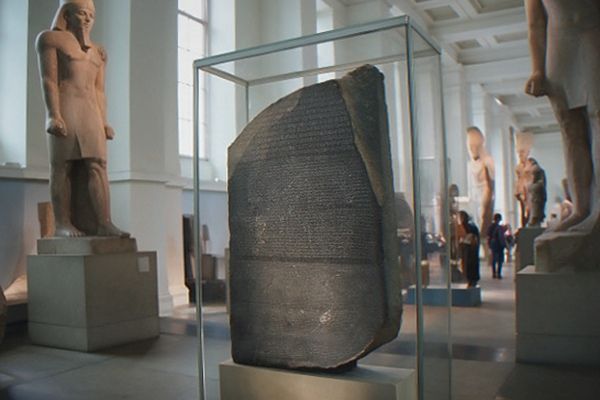
Start with the stone itself, because it explains everything that follows. The Rosetta Stone is a granodiorite slab carved in 196 BC with the same priestly decree written three times: once in hieroglyphs, once in Egyptian demotic script, and once in ancient Greek. When French soldiers dug it up near the town of Rosetta at the end of the eighteenth century, scholars could still read Greek but not hieroglyphs, and the parallel texts became the key that unlocked two thousand years of silent inscriptions. The object you are looking at is not decorative. It is the single most important piece of codebreaking in the history of language study, and it stands close enough to the entrance that you can reach it within a few minutes of walking in.
The stone also teaches you how to read the rest of the museum. Its case is usually ringed by people, and the trick locals use is to look at the replica casts and the surrounding gallery first, then circle back when the crowd thins. The same pattern repeats at every famous object in the building: patience, or a well-timed arrival, buys you the view that the guidebooks photograph. Around the stone, the rest of the Egyptian sculpture gallery holds colossal statues of pharaohs and gods that set the scale for everything upstairs, so even the walk between highlights feels like part of the show.
The Parthenon sculptures, one floor over, are a different kind of encounter. These are the marble friezes, metopes and pediment figures removed from the Parthenon in Athens in the early nineteenth century, and they fill an elongated gallery built to echo the temple's proportions. The horsemen of the frieze, the reclining goddesses of the east pediment and the famous river-god figure are arranged so that the light falls the way it did on the Acropolis. Walk the gallery slowly and the marble starts to read like a film: a procession of riders, herders, musicians and elders moving toward the temple, carved at a level of detail that rewards standing still.
That gallery is also the museum's most argued-about room, and that argument is part of what you are seeing: a live debate about ownership, empire and stewardship that has run for two centuries. The Greek government has long called for the sculptures' return to Athens; the museum maintains they are safest and most seen in London. You do not need to take a side to feel the weight of the question standing in front of the pediment figures, and many visitors find that the controversy makes the objects feel more alive, not less. It is a reminder that a museum visit can be an argument as well as a delight.
A little timing knowledge makes the five-object route far easier. The museum is open daily from 10am to 5pm, with later opening until 8.30pm on Fridays, and the quietest windows are weekday mornings right at opening and the Friday evenings, when most tour groups have gone. Entry is free but you can book a timed slot online in advance, which lets you skip the queue at the Great Court doors on busy days. The main entrance is on Great Russell Street, a short walk from Tottenham Court Road and Holborn stations.
Two small practical points round out the plan. The museum runs free daily eye-opener tours, each around 30 to 40 minutes long, that introduce a single gallery or theme, and the daily spotlight talks, lasting about 15 minutes, focus on a single object, sometimes one of the five on this list. Checking the talks schedule at the information desk when you arrive is the easiest way to add expert commentary to a self-guided visit without paying for a guided tour.
Do You Need Tickets And What Does Entry Cost?
No, you do not need a ticket for the British Museum's permanent collection. Entry is free year-round, and advance booking is recommended but not required; the museum uses timed entry to manage crowds, so a free slot reservation helps at peak times. Only special exhibitions and some events are paid. A guided highlights tour booked through an operator runs from $9.31 per person and holds a 4.3 rating across 978 reviews.
The free entry point matters more here than at almost any other museum in the city. Of the 48 museums covered across London Museums, 20 charge nothing to enter, and the British Museum is the flagship of that free tier. What still costs money inside are the temporary exhibitions, which the museum stages several times a year around subjects ranging from ancient Rome to modern printmaking, and some talks and evening events. If your visit is built around the five highlights above, you will not spend a pound on the door.
If you want a guide rather than a map, that is where the paid option comes in. The operator's live listing offers a highlights tour from $9.31, and reviewers consistently praise the way it compresses the museum's sprawling collection into a walk that makes sense. Slots on the early tours go first at weekends, so if a Saturday visit is on your plan, booking ahead is the one genuinely useful piece of urgency on this page. The tour pairs well with the free entry: you pay a small amount for interpretation, not for the door.
For visitors who prefer to skip the logistics entirely, a booked tour also solves the timed-entry question, because the operator handles the slot. If you would rather go independently, the museum's own visit pages walk you through reserving a free entry slot and checking which exhibitions are running during your dates. That page is also where you verify opening hours before you travel, since seasonal adjustments and private evening events can shift the last entry time on particular days.
How Long Should You Allow And How Do The Galleries Flow?
Allow three to four hours for the five highlights at a relaxed pace, or around ninety minutes if you move briskly and skip the side galleries. The Rosetta Stone and the Parthenon galleries sit on the ground floor, while the mummies and the Sutton Hoo and Lewis Chessmen rooms sit on the upper floors, so a sensible route works upward through the building and finishes with a descent through the Great Court. Weekend crowds stretch every estimate.
The single biggest timing mistake visitors make is treating the museum like a corridor rather than a building with vertical logic. Arriving at the Great Court, most people drift into the Egyptian sculpture gallery, meet the stone, and then discover that the mummies they came for are a full floor above them. Working upward fixes this. The ground floor holds the stone and the Parthenon gallery, the upper floor holds the Egyptian death and afterlife rooms, the medieval rooms with Sutton Hoo and the chessmen, and the Japanese galleries that make a rewarding final stop.
The mummy galleries deserve more time than the guidebook shorthand suggests. The death and afterlife rooms hold not just wrapped bodies but the entire Egyptian philosophy of death: painted coffins, canopic jars, the Book of the Dead papyri, and the animal mummies that reveal how ordinary Egyptians practiced the same rituals for their cats and ibises. The famous painted mummy cases from Thebes are among the most photographed objects in the building. Give this wing the better part of an hour if you have it, because the labelling here is some of the museum's best storytelling, walking you through what each object meant to the people who made it.
Sutton Hoo, by contrast, is a single dramatic room. The helmet, the purse lid, the shoulder clasps and the great shield come from a seventh-century ship burial excavated in Suffolk on the eve of the Second World War, and the display reconstructs the moment archaeologists lifted the sand to find an Anglo-Saxon king's grave goods laid out as if for a voyage. The helmet's empty face, with its garnet eyebrows and dragon-shaped crest, has become the museum's unofficial second emblem. Two rooms away, the Lewis Chessmen, carved from walrus ivory in the twelfth century and found on a Scottish beach in the nineteenth century, close the loop with objects that are simultaneously scholarly treasures and strangely lovable: the berserkers biting their shields, the melancholy queen resting her cheek on her hand.
| Highlight | Where to find it | Floor | Realistic time |
|---|---|---|---|
| Rosetta Stone | Egyptian sculpture gallery, near the main entrance | Ground | 10-15 minutes |
| Parthenon sculptures | The long Parthenon gallery | Ground | 35-45 minutes |
| Egyptian mummies | Death and afterlife galleries | Upper | 45-60 minutes |
| Sutton Hoo ship burial | Medieval Europe gallery | Upper | 20-25 minutes |
| Lewis Chessmen | Neighbouring medieval room | Upper | 15-20 minutes |
For a fuller plan that puts this museum in a multi-day route, the three-day London museum itinerary builds a schedule around exactly these kinds of room-by-room timings, and the best museums in London guide ranks where this collection sits against the rest. Both are worth a read before you commit a day, because the honest answer to "how long" depends on what else your week holds, and a museum this deep can quietly swallow an entire day if you let it.
How Does The British Museum Compare With Its Nearest Alternative?
The British Museum's nearest true alternative is the free National Gallery, fifteen minutes' walk away, which covers painting rather than world archaeology; the nearest paid alternative in the same Bloomsbury neighbourhood is the Postal Museum, which charges GBP 18.50 for adults and offers ride-based, family-focused history. Neither replaces the other: the British Museum is the deeper collection, the Postal Museum is the more interactive one, and the National Gallery is the closest free companion.
Comparisons help most when they are about the day you are actually planning. A visitor with one free afternoon in central London can walk from Trafalgar Square to Bloomsbury in under twenty minutes, and the two free institutions pair naturally: paintings in the morning, archaeology in the afternoon, with lunch between. The National Gallery's collection of Van Eyck, Velazquez and Turner answers a different hunger than the Rosetta Stone does, and because both are free, the pairing costs nothing but shoe leather. The do I need tickets to the British Museum post covers that pairing's logistics in detail, including how the two timed-entry systems differ.
Families weigh the comparison differently. The Postal Museum, a short walk north in Phoenix Place, charges GBP 18.50 for adults and GBP 11 online for children aged 2 to 15, and its centerpiece is a ride on the narrow-gauge Mail Rail trains through the tunnels that once carried London's post beneath the streets. Where the British Museum rewards reading and patience, the Postal Museum rewards pressing buttons and riding trains, and children under a certain patience threshold will get more from the smaller museum. Its tour listing runs from $27.77 and holds a 4.6 rating across 477 reviews, a strong signal for a museum of its size.
A third contrast, further afield, is Greenwich's Painted Hall, which offers the opposite experience again: a single overwhelming painted interior rather than thousands of objects, with a tour listing from $23.71 and a 4.5 rating across 266 reviews. Choosing between them is really choosing a mood. The British Museum is about the sweep of human history in one building; the Painted Hall is about standing inside one masterpiece for an hour. Both reward a slow approach, and neither can be rushed without losing the point.
The British Museum's own scale is the honest caveat in every comparison. Dozens of galleries, several floors, and a collection that spans millions of years of human making means no visit feels finished, and that is by design. The five highlights above are the museum's way of being manageable; everything else is the reason people come back. The museum's official site publishes the current gallery closures and exhibition schedule, which is worth a glance before any visit, because individual rooms do close for conservation on rotation.
When Is The Best Time To Visit The British Museum?
Weekday mornings, especially in the first hour after opening, are the calmest window for the five highlights; weekends and school holidays bring the heaviest crowds and can double the time each object takes to see. The museum opens on Mondays, unlike many continental European museums, so a Monday visit needs no special planning. Late afternoon visits work for the ground-floor highlights but leave little time for the upper floors.
Crowd behaviour at this museum follows a predictable daily rhythm, and knowing it changes the visit more than any ticket decision. The Rosetta Stone is the first place most tour groups walk to, which means the Egyptian sculpture gallery is at its busiest in the first hours after opening and again after lunch. The Parthenon gallery, one floor over, stays calmer for longer because it is a longer walk from the entrance. The upstairs mummy galleries peak in the middle of the day. A visitor who starts upstairs and finishes downstairs effectively inverts the crowd pattern and sees each highlight with more room to breathe.
Season matters too. The summer holidays and the Christmas period bring the fullest galleries of the year, while late autumn and the weeks after the January holidays are the quietest stretch in the museum's calendar. None of this affects the price, because the permanent collection is free year-round, but it affects how long you need. On a crowded August Saturday, the three-hour route can stretch toward a full day; on a quiet February Tuesday morning, the same route can feel almost private. If your dates are flexible, choose the day before you choose the hour.
For visitors who want the security of a guide through all of this, the options below gather the three listings most relevant to this plan: the British Museum highlights tour itself, the Postal Museum for the family contrast, and the Painted Hall for the single-masterpiece alternative. Each one covers a different mood of London museum-going, and the British Museum listing remains the cheapest of the three, which fits a plan built around a free collection.
Common Questions About The British Museum
What are the top five things to see at the British Museum?
The Rosetta Stone, the Parthenon sculptures, the Egyptian mummies in the upstairs death and afterlife galleries, the Sutton Hoo ship burial finds, and the Lewis Chessmen. All five are in the free permanent collection, and a focused route through them takes roughly three hours.
Is the British Museum free to enter?
Yes, entry to the permanent collection is free year-round. Special exhibitions and some events carry a separate charge, and booking a free timed-entry slot in advance is recommended for busy periods but not required.
How long does a visit to the British Museum take?
Three to four hours covers the five highlights at a relaxed pace; ninety minutes is possible if you move quickly and skip side galleries. Weekend crowds stretch every estimate, so weekday mornings are the calmest window.
Do I need to book British Museum tickets in advance?
For the free permanent collection, advance booking is recommended but not required; the museum uses timed entry to manage crowds. For special exhibitions and guided tours, advance booking is the practical route, and weekend tour slots sell first.
Are the Egyptian mummies included in free entry?
Yes. The mummy galleries upstairs are part of the permanent collection and cost nothing to enter. Only temporary exhibitions and ticketed events are charged separately.
Is the British Museum good for children?
It can be, but it rewards preparation. The mummies, the Sutton Hoo helmet and the Lewis Chessmen hold children's attention well, while hours of stone sculpture generally do not. Families with younger children often prefer the more interactive Postal Museum nearby.