What Should I See At The V&A?
A room-by-room answer to what to see at the V&A in London, from the Cast Courts to the jewellery gallery, plus what a ticket covers and how long to allow.
 By James Whitfield, London Museums And Travel Writer
What Should I See At The V&A?
See the Cast Courts first, then the jewellery gallery, the fashion galleries, Tipu's Tiger, and the Raphael Cartoons, in roughly that order. Entry to the V&A is free, no booking is required for general admission, and the museum sits on Cromwell Road in South Kensington, a short walk from South Kensington Tube station. Most first visits settle around two to three hours, which is enough for the highlights below.
The Victoria and Albert Museum is the world's largest museum of decorative arts and design, and that breadth is both its gift and its trap. A visitor who tries to see everything ends up shuffling past cases of ceramics with glazed eyes, while a visitor with a plan gets to the objects people actually cross the city for. The museum grew out of the Great Exhibition held in London in the middle of the nineteenth century, and Prince Albert's original idea was a place that would teach British designers by showing them the best work ever made anywhere. That mission explains the strange, wonderful mix inside: sculpture casts beside haute couture, Islamic metalwork beside a mechanical tiger from India.
The building itself deserves a minute of attention before you start. The main entrance on Cromwell Road opens into a lobby crowned by a large glass chandelier by Dale Chihuly, and the café beyond it, with its Morris and Gamble rooms, is one of the most beautiful museum cafés in Europe. Refreshments are not free, of course, but sitting under those painted tiles costs nothing and is a genuine part of the visit. The café was designed as part of the original museum experience, and the architects clearly intended refreshment to be an aesthetic event in its own right rather than a refuelling stop.
If you are the kind of visitor who likes a themed sweep, our broader art museums in London guide places the V&A alongside the National Gallery and Tate Modern and explains which one suits which kind of traveller. The short version for this page: the V&A is for objects, the National Gallery is for paintings, and Tate Modern is for the last century. A visitor who loves standing in front of a single painting for ten minutes will feel restless here, while a visitor who wants to know how a chair was jointed or a gown was stitched will feel at home within minutes.
Which Galleries Should You Prioritise?
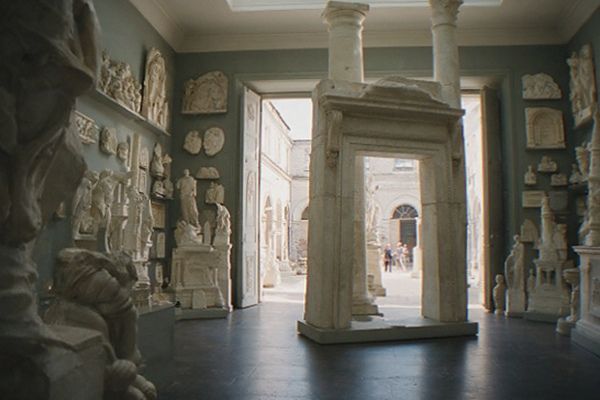
Start with the Cast Courts on the ground floor, where full-size plaster casts of monuments including Trajan's Column stand two storeys high, then move to the jewellery gallery on the first floor, which holds over 3,000 pieces spanning more than six centuries. After those, the fashion galleries and the sculpture rooms give the best return on limited time. Together these four areas are the core of the museum.
The Cast Courts are unlike anything else in London. In the nineteenth century, when travel was slow and photography young, the museum sent teams to make exact plaster replicas of Europe's great sculpture, and the results were assembled into two vast halls. Trajan's Column from Rome is cut into two stacked sections so it fits under the ceiling. Michelangelo's David stands here too, in cast form, giving visitors a close look at the surface in a way the original in Florence never allows. The rooms feel like a cabinet of giants, and they are the single most reliable wow moment in the building, working on visitors of every age and every level of art knowledge.
The jewellery gallery is quieter and, for many visitors, the surprise favourite. Displays run from medieval goldsmiths' work through to contemporary pieces, and the lighting design, with objects spotlit against dark backgrounds, makes even simple rings look theatrical. It is the kind of gallery where people slow down without being told to. The cases are arranged so that you can trace the evolution of technique, from hammered gold to cut gemstones to modern experimental materials, without needing to read every label.
Fashion is the V&A's strongest suit among the modern collections. The galleries trace dress from the eighteenth century to the present, and the rotation means regular visitors see new things each year. Textiles are fragile and cannot stay on permanent display, so what you see is a curated sample of a much larger holding, one of the largest fashion and textile collections in the world. If you visit twice in one year, the mannequins will likely be wearing different things.
Here is a practical short list, ordered so the walk between stops makes sense.
| Priority | Gallery or object | Floor | Why it matters |
|---|---|---|---|
| 1 | Cast Courts | Ground | Full-size casts of Trajan's Column and David, unique in scale |
| 2 | Jewellery gallery | First | Over 3,000 pieces across six centuries of design |
| 3 | Tipu's Tiger | Ground | A famous late eighteenth-century mechanical organ shaped as a tiger attacking a soldier |
| 4 | Fashion galleries | Ground and lower | One of the world's largest dress and textile collections |
| 5 | Raphael Cartoons | Level 0, gallery 48a | Monumental Renaissance cartoons on loan, painted for tapestries in the Sistine Chapel |
| 6 | The Great Bed of Ware | British Galleries | A famously oversized four-poster, mentioned by Shakespeare |
| 7 | Silver galleries | Ground floor, east | Sweeping silverwork in a galleried hall |
Tipu's Tiger deserves its own sentence. The carved and painted wooden organ, made in India in the late eighteenth century for the ruler of Mysore, has a crank handle that makes the tiger appear to maul a European soldier while a small organ inside growls. It is macabre, ingenious and unforgettable, and it sits in a case you can walk all the way around. Children either love it or find it slightly alarming, and either reaction makes it one of the most memorable objects in any London museum.
What Does A Ticket Cover And What Costs Extra?
General admission to the V&A is free, year-round, and no booking is required for the permanent collection. What still costs money are the ticketed temporary exhibitions and some events, which are priced separately and vary by show. Children under 18 are generally free or pay reduced rates for exhibitions. A booked ticket through the operator's live listing, from $27.09, covers entry and is worth considering at peak times.
This is where many visitors get confused, so it is worth being plain. The free entry covers the Cast Courts, the jewellery gallery, the fashion galleries, the British Galleries, the Raphael Cartoons and every other permanent display. You can walk in, see the highlights above, and spend nothing beyond your Tube fare. The museum recommends advance booking for busy periods, but for the collection itself a booking is a convenience, not a requirement. Nothing about the free entry is conditional on a donation, and there is no suggested amount at the door.
The temporary exhibitions are a different matter. The V&A's blockbusters, on subjects ranging from haute couture designers to video game design, are ticketed, they are often the reason a visitor comes in the first place, and their prices change from show to show. Check the current price on the museum's own site for whichever exhibition is running during your visit, because no fixed figure applies across the year. Some shows also run timed entry slots of their own, separate from the general admission flow, so an exhibition ticket may specify an arrival window even though the rest of the museum does not.
One thing to watch on the museum's own pages: UK charity venues display a higher Gift Aid price beside the standard one, and the standard price is the one you actually pay unless you choose to donate. That applies to exhibition tickets here just as it does at other London institutions. The Gift Aid figure includes a voluntary donation, and while supporting the museum that way is a fine thing to do, no visitor should read it as the compulsory price.
How Long Should You Allow?
Allow two to three hours for a highlights visit built around the four core galleries, and half a day if you want to add a temporary exhibition or the café properly. A full day suits visitors with deep interest in fashion, sculpture or metalwork. The museum is large, spread over six levels, and the distances between galleries add up faster than the map suggests.
Two hours is the realistic minimum for the short list in the table above, walked at a steady pace with brief stops. Three hours lets you read some labels and sit down once. Visitors who add a ticketed exhibition should treat that as its own block of an hour or more on top, because the exhibition halls are at the far ends of the building from the main entrance. Anyone who tries to compress the collection into a single hour will leave having seen the Cast Courts and not much else, and will wrongly conclude the museum is exhausting.
Families move slower. The V&A rewards wandering more than it rewards children's trails in some rooms, though the sculpture and cast galleries are genuinely fun with kids because everything is big and nothing is behind intimidating barriers. If you are planning a trip with children in tow, our London museums for kids guide compares how the V&A stacks up against the Science Museum and the Natural History Museum, both of which are a five minute walk away. Many families do one museum in the morning, lunch in the museum quarter, and a second museum in the afternoon, which works precisely because all three are free and none punishes a short visit.
Time of day matters more here than at most museums. The Cromwell Road entrance absorbs school groups mid-morning during term time, and the galleries nearest the entrance feel them. Late afternoon is calmer, and the museum stays open into the evening on Fridays during much of the year, which makes it one of the few London museums that works well after a full day of sightseeing. A Friday evening visit, with the café lit and the crowds thinned, is one of the more underrated museum experiences in the city.
How Does The V&A Compare With The National Gallery And Tate Modern?
The V&A holds objects rather than paintings, so choose it for design, fashion, sculpture and decorative arts; choose the National Gallery for Old Master paintings, and Tate Modern for modern and contemporary art. Both alternatives are also free to enter for their permanent collections. A visitor with one afternoon should pick one, not two, because each rewards unhurried attention.
The National Gallery on Trafalgar Square is the nearest real alternative in spirit, even though it is a different kind of museum entirely. Its strength is European painting from the thirteenth to the early twentieth century, and if what you want from a museum is to stand in front of a Van Gogh or a Vermeer, that is where you go. The V&A cannot offer that, and does not try. Its paintings are few; its Raphael Cartoons are the exception, and they are cartoons, full-size preparatory paintings for tapestries, not finished panel paintings.
Tate Modern is the third vertex of the triangle. It is free to enter for the collection, it sits across the river at Bankside, and its temporary exhibitions are ticketed in the same way the V&A's are. Visitors who find decorative arts fussy often love Tate Modern's scale and boldness, and the reverse holds too. There is no wrong answer, only a match between the museum and the mood. Some travellers alternate between the two on successive trips to London and report that the contrast is exactly what keeps both fresh.
For visitors who want paintings with a guide rather than alone, the National Gallery's own guided ticket, listed on the operator's live listing, is the natural companion to a V&A visit made independently. Doing both museums in one day is possible, since Trafalgar Square and South Kensington are about twenty minutes apart by Tube, but it turns both into a checklist. A calmer plan is the V&A on one day and the National Gallery on another, each with the time it deserves.
| Museum | Nearest Tube | Permanent collection | Best for | Entry |
|---|---|---|---|---|
| V&A | South Kensington | Decorative arts, fashion, sculpture, jewellery | Objects, design history, café | Free, no booking required |
| National Gallery | Charing Cross | European paintings, 13th to early 20th century | Old Masters in one building | Free, booking recommended at busy times |
| Tate Modern | Southwark | International modern and contemporary art | Bold modern art, river views | Free, no booking required for collection |
What Should First-Time Visitors Know Before Going?
Arrive through the Cromwell Road entrance, pick up a floor plan at the desk, and decide on three or four target galleries rather than trying to cover the building. Entry is free and no ticket is needed for the collection, so there is no cost to a short visit. The museum is a five minute walk from South Kensington station via a pedestrian tunnel that spares you the rain.
The tunnel is a genuinely useful local secret. The South Kensington pedestrian underpass connects the Tube station directly to the museum quarter, and on a wet day it means you reach the V&A, the Science Museum and the Natural History Museum without opening an umbrella. For anyone building a day around more than one museum, our South Kensington museums guide lays out how to sequence all three, including where to eat between them and which order minimises backtracking.
Photography is allowed in the permanent galleries, with the usual exceptions around loan objects marked by signs. Bags larger than a small daypack are not permitted in the galleries and there is a cloakroom, so travel light. The museum is fully step-free, with lifts reaching every level, and the layout, built in stages over many decades, means the shortest route between two rooms is rarely a straight line. Trust the floor plan over your sense of direction, and do not be shy about asking the floor staff, who know the shortcuts between wings that no map makes obvious.
Weekends draw the biggest crowds, and the late-opening Fridays are the calmest time to see the fashion galleries without a queue at the door. School holidays change the feel of the ground floor considerably. If your dates are flexible, a weekday afternoon in term time is the closest thing this museum has to a quiet hour. Rain, notably, does the opposite of what you might expect: the pedestrian tunnel delivers damp crowds straight to the entrance, so a wet Saturday can feel busier than a dry one.
Should You Book Anything In Advance?
For the permanent collection, no booking is required, so there is nothing you must arrange ahead. For ticketed temporary exhibitions, booking ahead is the sensible move, because popular shows sell out for weekend slots first. A pre-booked entry ticket from the operator's live listing, from $27.09, simply removes the queue at the door and is most useful at peak times.
The honest framing is this: the V&A does not need to be booked the way the Tower of London does, where timed entry is required and adult admission is GBP 37. Here the booking question is really an exhibition question. If a major show is running during your visit and you want to see it, book that show. If you are coming for the Cast Courts and the jewellery gallery, walk in. The contrast with the paid museums nearby is worth knowing: Kensington Palace, a short walk north, charges GBP 24.70 for adults and requires timed entry, so the V&A's walk-in freedom is not universal in this neighbourhood.
One pattern worth knowing: slots on guided visits and exhibition entries go first at weekends, and midweek availability usually lasts longer. Visitors with flexible dates can often skip pre-booking entirely by coming Tuesday to Thursday. Visitors locked into a Saturday should book whatever they care about seeing, and accept that the busiest rooms will feel busiest then regardless.
Common Questions About The V&A
What should I see at the V&A?
See the Cast Courts, the jewellery gallery, the fashion galleries, Tipu's Tiger and the Raphael Cartoons. Entry to the permanent collection is free and no booking is required, so a two to three hour highlights visit costs nothing but your time.
Is the V&A free to enter?
Yes. General admission is free year-round, and no booking is required for the permanent collection. Ticketed temporary exhibitions and some events cost extra, and their prices vary by show.
How long does a visit to the V&A take?
Allow two to three hours for the highlights, half a day if you add a temporary exhibition, and a full day only if you have a deep interest in a particular collection such as fashion or metalwork.
Do I need tickets for the V&A London?
No ticket is needed for the permanent collection. Advance booking is recommended for busy periods and is required for ticketed temporary exhibitions, but general admission needs nothing more than walking in.
What is the V&A famous for?
It is the world's largest museum of decorative arts and design, famous for the Cast Courts, its fashion and textile collection, the jewellery gallery, Tipu's Tiger and the Raphael Cartoons.
Is the V&A better than the Natural History Museum next door?
They serve different interests. The V&A is for design, fashion and decorative arts; the Natural History Museum is for dinosaurs, earth sciences and wildlife. Both are free, and they are a five minute walk apart, so many visitors do both.